Asbestos air monitoring,
analyzed in-house
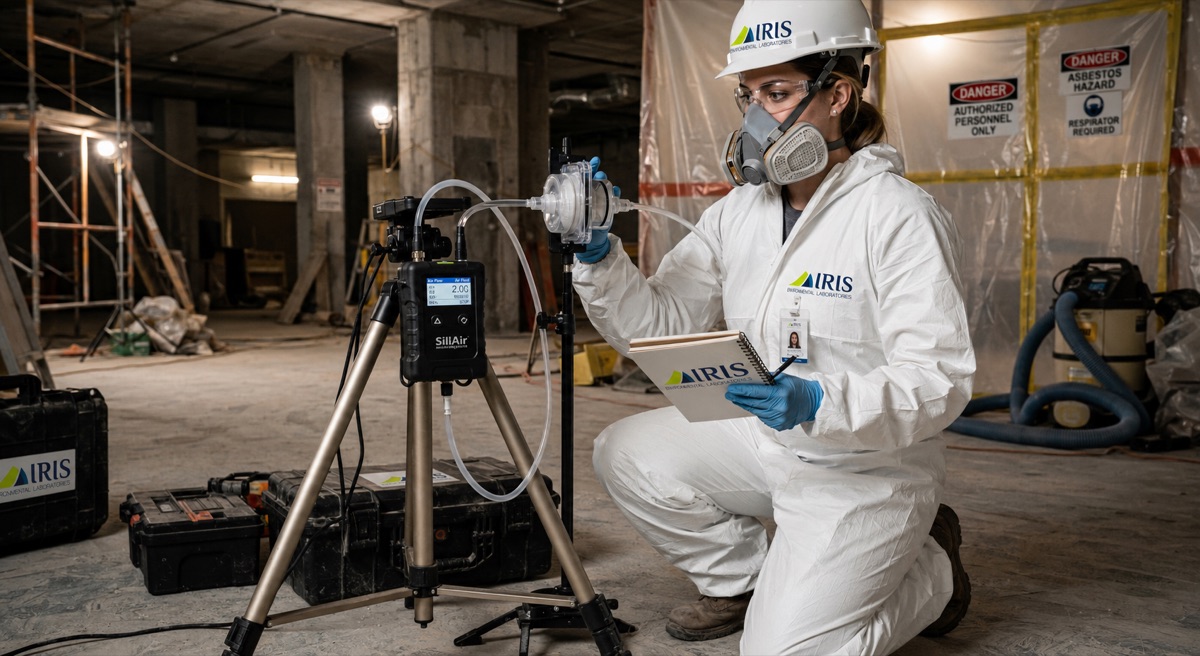
Licensed field professionals collect air samples. Our NVLAP-accredited lab runs them by NIOSH 7400 PCM (or TEM when the regulator wants it). PCM results in 24 hours; same-day rush available for abatement clearance work.
Three types of asbestos air monitoring
Work-area and perimeter monitoring. Fixed-location air samples are collected within and around the regulated work area during asbestos abatement. This monitoring helps evaluate containment performance, negative-air controls, and the potential migration of airborne fibers beyond the work zone.
Personal exposure monitoring. Air samples are collected from the breathing zone of workers performing asbestos-related activities. Results are used to assess employee exposure against applicable OSHA occupational exposure limits and to support the contractor’s exposure-monitoring and employee-protection records.
Post-abatement clearance monitoring. After the work area has been thoroughly cleaned and passes visual inspection, clearance air samples are collected to confirm that airborne fiber concentrations meet the applicable reoccupancy criteria. When required, aggressive air sampling uses air-moving equipment to disturb any remaining settled fibers before samples are collected.
Method by job type
We pick the method that matches the regulatory framework you're filing under.
NIOSH 7400 PCM
Use case: Routine OSHA exposure monitoring, post-abatement clearance under most state rules.
Detection limit: 0.005 f/cc on a typical 1,200 L sample.
TAT: Same-day on a 4-hour rush, standard 24 hours.
TEM (AHERA / ASTM D6480)
Use case: School clearance under AHERA, NYC ACP-7 abatement clearance, any project that requires fiber-type discrimination.
Detection limit: 0.005 s/cc, lower with higher sample volumes.
TAT: 48 hours standard, 24-hour rush.
Yamate Level II
Use case: Indoor-air baseline studies and quality-assurance work that requires Level II TEM analysis.
TAT: 3–5 business days.
Background & pre-abatement
Use case: Establish a baseline before friable abatement begins so post-abatement levels have something to be measured against.
TAT: Same as PCM or TEM, depending on method.
Air monitoring is required when…
Friable abatement is underway
Most state regs require control and clearance monitoring on any project disturbing friable asbestos-containing materials.
OSHA exposure tracking
Employers must run personal-exposure monitoring on workers with reasonable potential for asbestos exposure (29 CFR 1910.1001).
School / AHERA work
K-12 buildings under AHERA require TEM clearance after any abatement project. We routinely run AHERA TEM clearance for districts in NJ, NY, and FL.
Need this analysis today?
Ship samples to our Union, NJ intake or schedule field collection. Same-day, 24 and 48-hour turnaround available for wholesale partners.